The Facts
What Flock Safety cameras are, what they do with your data, and what the record shows about how they get used. Each section stands on its own, so skip to what matters to you.
What is a Flock Safety camera?
Flock Safety cameras are small, pole-mounted units that read license plates automatically. Each one photographs every vehicle that drives past, recording the plate number, timestamp, location, vehicle make and model, and direction of travel. The system runs continuously, with no human deciding when to capture.
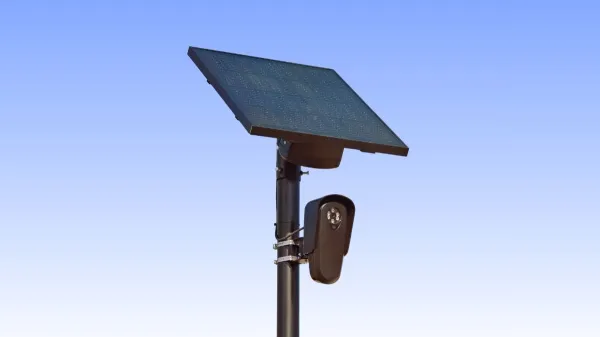
The data goes into Flock's cloud database, where it's accessible to law enforcement agencies across the country. Denver's 111 cameras scan roughly 2 million plates per month (CBS News). Most of those plates belong to people with no connection to any crime.
Flock markets the cameras as a tool to recover stolen vehicles and solve property crimes. The system has no way to know in advance which vehicles are relevant. It logs everyone.
What the records show
Both cities provided contracts in response to Alabama Open Records Act requests in 2026. This section reports what those documents say.
Auburn
In the records the City provided, Auburn does not buy the cameras directly from Flock. The City pays Alabama Power Company under a Master Contract for Public Safety Services. Alabama Power keeps title to the cameras, poles, and solar panels. The contract lists Flock Safety as the software provider and requires the City to follow Flock's terms of service.6
- June 2020: The City signs its first contract with Alabama Power, for five cameras at $833.35 a month. The copy provided carries only the City's signature.
- October 2020: One camera is added at $229.17 a month.
- August 2021: One more camera is added at $229.17 a month.
- September 2024: The City signs a new master contract. The monthly charge for the original five cameras rises to $1,354.20, an increase of 62.5 percent. The payment schedule is stated as beginning April 29, 2024.
At those monthly rates, the seven cameras cost about $21,750 a year, before annual increases of up to 3 percent. Those are contract rates, not payments. Invoices and payment records were not among the records provided, and the City says no single document shows the total it has paid.
Every contract exhibit specifies 30-day cloud storage. The contract treats the maps of camera locations as confidential. It also lets Alabama Power authorize disclosure of the data to third parties, with or without notice to the City, in connection with law enforcement investigations, court orders, or as the law allows.
The contracts were signed by city staff. The records the City provided include no council resolution or meeting minutes approving them. Council agendas and packets are posted on the City's public agenda site, and the records provided do not say whether the council acted on these contracts. The City says it has fully responded to the request it received and that any other records would need a new request.
Opelika
Opelika buys directly from Flock. Its city council approved the contracts by resolution on November 3, 2020, December 19, 2023, and May 7, 2024. Each resolution treats Flock as a sole-source vendor. The current contract covers 15 cameras at $113,800 over three years, with 30-day retention.7
In two of the three cases, the order form was signed before the council vote. The mayor's signature on the 2020 order form reads October 9, 2020, and the amended 2024 order form was signed April 12 and 15, 2024. The resolutions describe the votes as approving, ratifying, and confirming the purchases.
The order forms list 15 cameras. The resolutions describe six cameras in 2020 and then two additional systems in 2023 and 2024. The records do not explain the other seven.
The contract lets the City end it for non-appropriation of funds with 30 days written notice and no penalty. It renews automatically unless either side gives 30 days notice before the term ends.
Where the data goes
Flock says its network connects roughly 5,000 law enforcement agencies nationwide. When your plate is scanned in Auburn or Opelika, agencies far beyond Lee County can query that record.
Before Virginia enacted ALPR regulations in 2025, ICE accessed local Flock data thousands of times. A single small Virginia town's camera network was searched nearly 7 million times by outside agencies in one year (Virginia State Crime Commission, January 2026).
Alabama has no state law governing ALPR data. There are no local rules limiting which agencies can search Auburn's or Opelika's camera records, how long the data is kept, or under what circumstances federal agencies can request it.
What they say it does
Flock Safety's marketing claims, measured against the available evidence.
When it goes wrong
False positives
ALPR systems misread plates. When they do, the person driving that vehicle gets treated as a suspect. These are documented cases, not hypotheticals.
- Aurora, CO. A family, including a 6-year-old, was held at gunpoint after an ALPR misread a plate. The city settled for $1.9 million.1
- Española, NM. A 12-year-old was handcuffed after the system misread a digit and flagged the vehicle as stolen.2
- Cherry Hills Village, CO. Kyle Dausman was stopped twice on the same erroneous alert. Flock told local police the error could not be corrected at the local level.2
- Thanksgiving stop. Brian Hofer's family was held at gunpoint on a holiday after an ALPR alert flagged their vehicle in error.1
Officer misuse
Access to a vehicle's movement history is a significant power. In several documented cases, officers have used that access for personal purposes.
- Menasha, WI (January 2026). A police officer was charged with using Flock to track his ex-girlfriend's vehicle.3
- Sedgwick County, KS. The police chief conducted 164 unauthorized searches of the ALPR system and resigned.4
- Kechi, KS. A police lieutenant was arrested for using the system to track his estranged wife.5
The revolving door
Flock Safety has hired elected officials and public figures after they were involved in approving contracts with the company.
In Cleveland, the city council's majority leader resigned and joined Flock's team. A $2 million no-bid contract with the city followed (Consumer Rights Wiki). In Moreno Valley, CA, a sitting mayor accepted a position with Flock while still in office.
For the full documentation, consumerrights.wiki has sourced records on both cases.
Communities saying no
As of October 2026, 277 communities have canceled or rejected Flock Safety contracts. These aren't all progressive cities. Flagstaff, AZ and Lockhart, TX are among them.
Some acted after a documented error or misuse case. Others decided they didn't want mass vehicle tracking before something went wrong. The full list and council toolkit are at deflock.org/council.
Sources
- 1.CBS News, "When license plate readers get it wrong"
- 2.Consumer Rights Wiki: Flock Surveillance
- 3.FOX 11, "Menasha police officer accused of using license plate recognition system to track his ex-girlfriend"
- 4.KAKE, "Sedgwick police chief tracked ex-girlfriend 164 times using license plate cams"
- 5.KWCH, "Kechi police lieutenant arrested for using police technology to stalk wife"
- 6.City of Auburn, Master Contract for Public Safety Services (Surveillance, Governmental) with Alabama Power Company, 2020 and 2024 versions, and Premises Exhibits A, B, and C. Provided by the City in response to an Alabama Open Records Act request, 2026. View Auburn's contract records.
- 7.City of Opelika, Resolutions 285-20, 371-23, and 111-24, with Flock Safety order forms and Master Services Agreement. Provided by the Opelika City Clerk in response to an Alabama Open Records Act request. View Opelika's contract records.
- deflock.org: national contract cancellations, council toolkit
- Virginia State Crime Commission (January 2026 audit): federal agency access data, ICE searches
- Electronic Frontier Foundation (EFF): ALPR data sharing and federal access
- Virginia Center for Investigative Journalism: Virginia network search data
- Records provided by the City of Auburn and the City of Opelika in response to Alabama Open Records Act requests, 2026.
Stay updated
Get notified when new information comes out.